

Similar Posts
How to use an impure function in VHDL
An impure function can read or write any signal within its scope, also those that are not on the parameter list. We say that the function has side effects. What we mean by “side effects” is that it is not guaranteed that the function will return the same value every time it is called with…
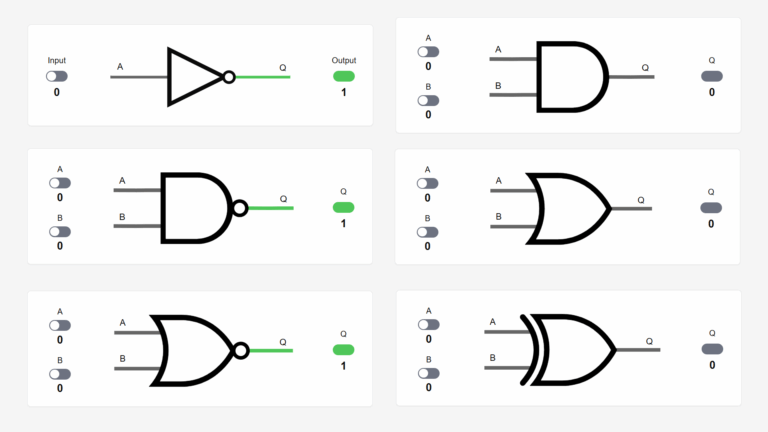
Logic gates interactive demo
The basic logic gates NOT, AND, NAND, OR, NOR, XOR, and XNOR are fundamental building blocks in digital circuits corresponding to Boolean operators.
Play with the switches to see how the outputs change! 😀
How to use a function in VHDL
Functions are subprograms in VHDL which can be used for implementing frequently used algorithms. A function takes zero or more input values, and it always returns a value. In addition to the return value, what sets a function apart from a procedure, is that it cannot contain Wait-statements. This means that functions always consume zero…
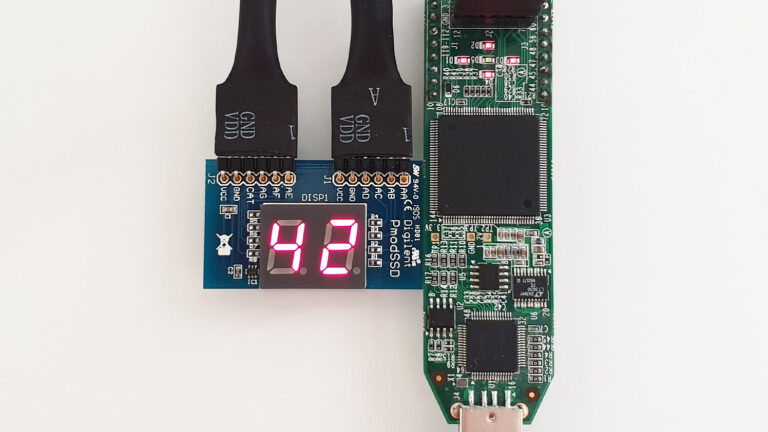
Dual 7-segment display FPGA controller
In this article, I will present a VHDL module that can display a two-digit number on the Pmod SSD: Seven-segment Display from Digilent. The dual 7-segment display is compatible with the Pmod interface, meaning that you can use it without any soldering. It fits into the Pmod connector, which is standard on many FPGA development boards.
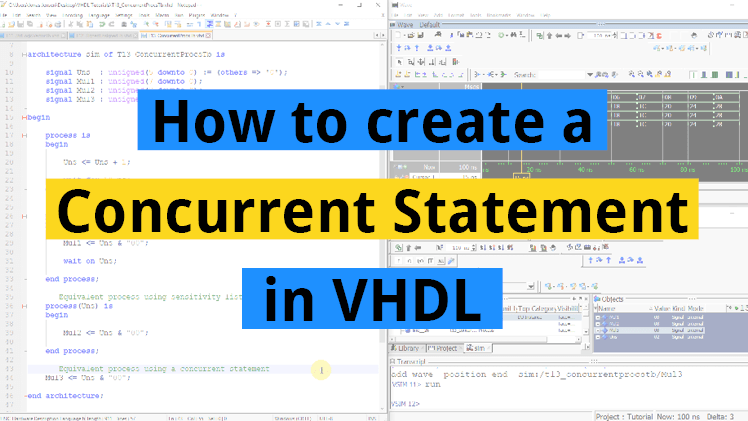
How to create a concurrent statement in VHDL
A concurrent statement in VHDL is a signal assignment within the architecture, but outside of a normal process construct. The concurrent statement is also referred to as a concurrent assignment or concurrent process. When you create a concurrent statement, you are actually creating a process with certain, clearly defined characteristics. Concurrent statements are always equivalent…
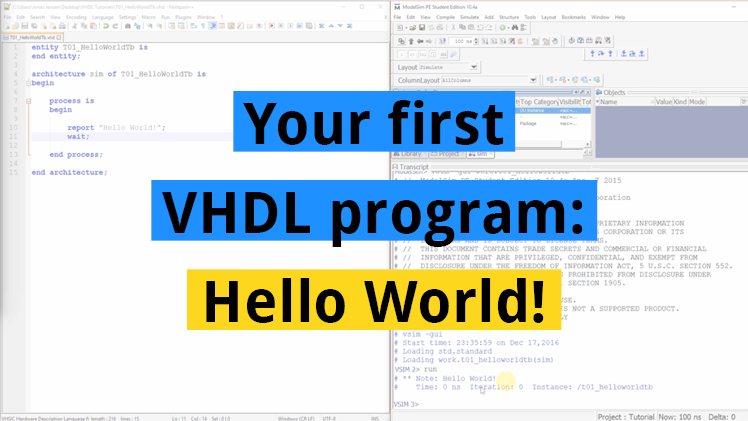
How to create your first VHDL program: Hello World!
When learning a new programming language, I always like to start by learning how to print. When you master outputting “Hello World!”, you know that you’ve got the environment working. It also shows you the basic skeleton of the language, the bare minimum code required to produce any output. You might be thinking: but VHDL…
Dear Jonas
Thanks for the content, thumbs up. please keep up the good work!
Best Regards
Thanks! That’s good to hear.
You are doing a very nice job. Top quality!
Thanks! I really appreciate your comment.
Hello Jonas
You really did save me by these great videos and materials.
These tutorials are the best thing on the internet.
Thank you for creating them.
Thanks! That’s encouraging to hear. I will do my best to keep up the quality of my blog posts.
Thank you so much man you are awesome! i learnt vhdl in university but i forgot after all years. i started again working. You help me too much! i will continue to course after this beginner course. i am planning the begin beginner fast track ! please dont stop the teaching us . thank you so much! greetings from turkey 🙂
Hello, Utku. Thank you for the nice comment! I’m glad you found my blog to be helpful. I will keep the free and premium content coming your way.
Thank you for providing such great content on a subject that imo can be tricky to really understand. But you make it easy for everyone!
That’s great to hear! I will keep on creating tutorials and articles for you. ?
Dear Jonas,
I’m an electronic engineer from Morocco, currently studying for a masters degree in microelectronics and sensors in France.
You helped me a lot to remember some of the vhdl basics and get more further into it.
I worked on an academic project using basys3 and vivado for a vga controller.
Thank you very much for this great content, keep up the good work.
I’m glad you like the quiz. It’s a good way to refresh your knowledge. 🙂
Excellent learning tool
Thanks! By the way, I also use quizzes in the VHDLwhiz membership.
Great tutorials! Short and sweet!
I’ll be sure to go onto the FPGA and VHDL Fast-Track after completing the basic tutorials..
Thanks, Dale! Also, check out the VHDLwhiz Membership, which gives you multiple courses, resource items, and coding challenges and supports your success in FPGA design.
Nice quiz, only problem is sharing your score on facebook is not working.
Thanks for the feedback. I’ve created a task on this. I’ll see if I can fix it when I have the time.