

Similar Posts
How to use a procedure in a process in VHDL
It is possible to drive external signals from a procedure. As long as the signal is within the scope of the procedure, it can be accessed for reading or writing, even if it isn’t listed in the parameter list. Procedures that are declared in the declarative region of the architecture, cannot drive any external signals….
Basic VHDL quiz
Have fun and learn from this VHDL and FPGA design quiz with 28 questions for beginners and intermediate learners in random order.
All questions include an explanation for the correct answer that will be shown after you make your selection.
How to use Wait On and Wait Until in VHDL
In the previous tutorial we learned the main differences between signals and variables. We learned that signals have a broader scope than variables, which are only accessible within one process. So how can we use signals for communication between several processes? We have already learned to use wait; to wait infinitely, and wait for to…
How to use a Case-When statement in VHDL
The Case-When statement will cause the program to take one out of multiple different paths, depending on the value of a signal, variable, or expression. It’s a more elegant alternative to an If-Then-Elsif-Else statement with multiple Elsif’s. Other programming languages have similar constructs, using keywords such as a switch, case, or select. Among other things,…
How to create a concurrent statement in VHDL
A concurrent statement in VHDL is a signal assignment within the architecture, but outside of a normal process construct. The concurrent statement is also referred to as a concurrent assignment or concurrent process. When you create a concurrent statement, you are actually creating a process with certain, clearly defined characteristics. Concurrent statements are always equivalent…
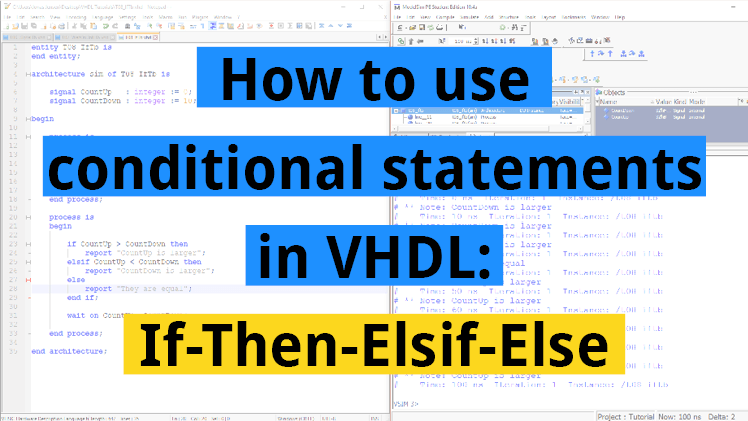
How to use conditional statements in VHDL: If-Then-Elsif-Else
In the previous tutorial we used a conditional expression with the Wait Until statement. The expression ensured that the process was only triggered when the two counter signals where equal. But what if we wanted the program in a process to take different actions based on different inputs? The If-Then-Elsif-Else statements can be used to…

Dear Jonas
Thanks for the content, thumbs up. please keep up the good work!
Best Regards
Thanks! That’s good to hear.
You are doing a very nice job. Top quality!
Thanks! I really appreciate your comment.
Hello Jonas
You really did save me by these great videos and materials.
These tutorials are the best thing on the internet.
Thank you for creating them.
Thanks! That’s encouraging to hear. I will do my best to keep up the quality of my blog posts.
Thank you so much man you are awesome! i learnt vhdl in university but i forgot after all years. i started again working. You help me too much! i will continue to course after this beginner course. i am planning the begin beginner fast track ! please dont stop the teaching us . thank you so much! greetings from turkey 🙂
Hello, Utku. Thank you for the nice comment! I’m glad you found my blog to be helpful. I will keep the free and premium content coming your way.
Thank you for providing such great content on a subject that imo can be tricky to really understand. But you make it easy for everyone!
That’s great to hear! I will keep on creating tutorials and articles for you. ?
Dear Jonas,
I’m an electronic engineer from Morocco, currently studying for a masters degree in microelectronics and sensors in France.
You helped me a lot to remember some of the vhdl basics and get more further into it.
I worked on an academic project using basys3 and vivado for a vga controller.
Thank you very much for this great content, keep up the good work.
I’m glad you like the quiz. It’s a good way to refresh your knowledge. 🙂
Excellent learning tool
Thanks! By the way, I also use quizzes in the VHDLwhiz membership.
Great tutorials! Short and sweet!
I’ll be sure to go onto the FPGA and VHDL Fast-Track after completing the basic tutorials..
Thanks, Dale! Also, check out the VHDLwhiz Membership, which gives you multiple courses, resource items, and coding challenges and supports your success in FPGA design.
Nice quiz, only problem is sharing your score on facebook is not working.
Thanks for the feedback. I’ve created a task on this. I’ll see if I can fix it when I have the time.