Basic VHDL quiz – Part 3
Test your progress with this VHDL quiz after completing tutorials 12-17 from the Basic VHDL Tutorial series!
The vast majority of VHDL designs uses clocked logic, also known as synchronous logic or sequential logic. A clocked process is triggered only by a master clock signal, not when any of the other input signals change. The basic building block of clocked logic is a component called the flip-flop. There are different variants of…
Creating modules is a great way to reuse code, but often you need the same module with smaller variations throughout your design. This is what generics and the generic map are for. It allows you to make certain parts of the module configurable at compile-time. Constants are used when we want to avoid typing the…
A module is a self-contained unit of VHDL code. Modules communicate with the outside world through the entity. Port map is the part of the module instantiation where you declare which local signals the module’s inputs and outputs shall be connected to. In previous tutorials in this series we have been writing all our code…
The Case-When statement will cause the program to take one out of multiple different paths, depending on the value of a signal, variable, or expression. It’s a more elegant alternative to an If-Then-Elsif-Else statement with multiple Elsif’s. Other programming languages have similar constructs, using keywords such as a switch, case, or select. Among other things,…
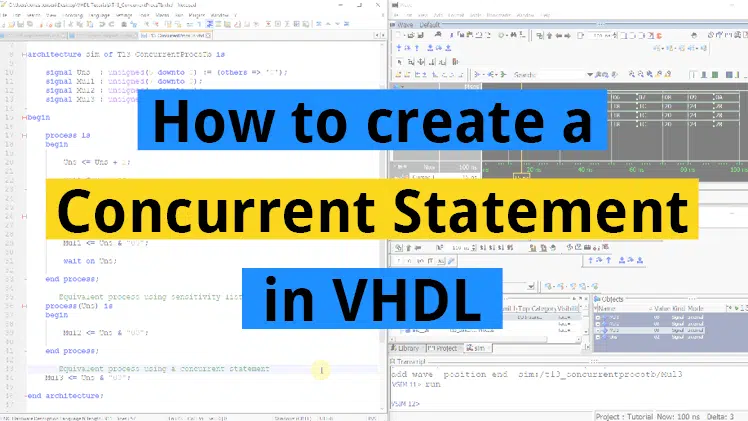
A concurrent statement in VHDL is a signal assignment within the architecture, but outside of a normal process construct. The concurrent statement is also referred to as a concurrent assignment or concurrent process. When you create a concurrent statement, you are actually creating a process with certain, clearly defined characteristics. Concurrent statements are always equivalent…
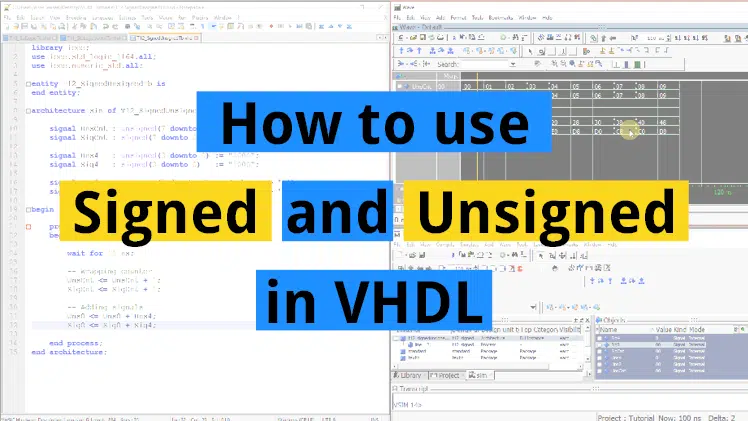
The signed and unsigned types in VHDL are bit vectors, just like the std_logic_vector type. The difference is that while the std_logic_vector is great for implementing data buses, it’s useless for performing arithmetic operations. If you try to add any number to a std_logic_vector type, ModelSim will produce the compilation error: No feasible entries for…
Test your coding skills with this VHDL quiz after completing tutorials 6-11 from the Basic VHDL Tutorial series!
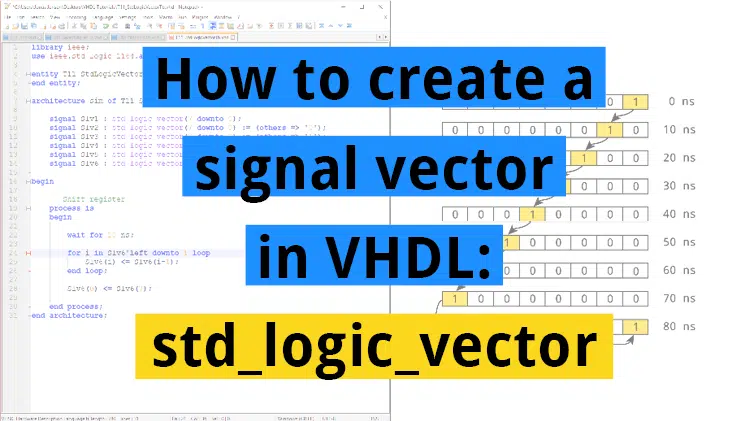
The std_logic_vector type can be used for creating signal buses in VHDL. The std_logic is the most commonly used type in VHDL, and the std_logic_vector is the array version of it. While the std_logic is great for modeling the value that can be carried by a single wire, it’s not very practical for implementing collections…
The most common type used in VHDL is the std_logic. Think of this type as a single bit, the digital information carried by a single physical wire. The std_logic gives us a more fine-grained control over the resources in our design than the integer type, which we have been using in the previous tutorials. Normally,…
End of content
End of content